
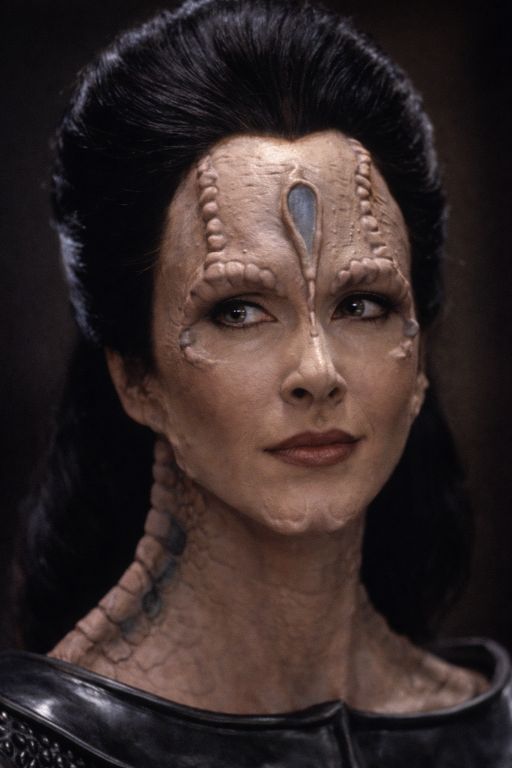
Glinn (CRD) Nareth Teral
Name Nareth Teral
Position Cardassian ship scientist
Rank Glinn (CRD)
Character Information
| Gender | Female | |
| Species | Cardassian | |
| Age | 55 | |
| Place of Birth | Lakaria City, Cardassia Prime |
Starfleet Info
Physical Appearance
| Height | 180cm | |
| Weight | 75kg | |
| Build | Lean | |
| Hair Color | Black (threaded with silver) | |
| Eye Color | Dark Brown | |
| Physical Description | Nareth is tall with a lean, controlled build. Her features are sharply defined even by Cardassian standards, with precise facial ridges and a strong jawline. Her hair is worn swept back from her face, dark with visible silver at the temples. Her skin shows the natural texture of age without diminishing her overall presence. |
Family
Personality & Traits
| General Overview | Nareth is a disciplined and self-possessed woman who values order, competence and personal responsibility. She is not unnecessarily harsh, but has little patience for carelessness, wasted words or emotional excess when something important is at stake. She tends to assess situations carefully before acting, and once she has reached a decision she is not easily moved from it. Though often read as stern or distant, her loyalty runs deep and her care is usually shown through practical action, steadiness and protection rather than open display. She is observant, measured and difficult to unsettle, with a habit of carrying difficult matters privately rather than asking others to share the burden. Nareth’s sense of duty has never been blind. Over time, her loyalty has shifted from the institutions she once served without question to a belief in what Cardassia could be, rather than what it has been. She is committed to the idea of a stronger, more stable future for her people, even if that future requires change. Beneath her control sits a quieter, more personal absence she does not speak of. She does not seek out her son, but the fact of him remains with her, carried without indulgence and without resolution. |
|
| Strengths & Weaknesses | Weaknesses: Nareth can be emotionally difficult to read and is often more comfortable enduring pain than speaking of it. Her self-control can become rigidity, and she has a tendency to carry responsibility alone, even when it would be wiser to let others stand beside her. Once she has decided something is necessary, she can be unyielding, sometimes at personal cost. Strengths: She is calm under pressure, highly reliable and not easily intimidated. Nareth is a careful judge of people and situations, values competence over appearance, and is capable of making difficult decisions without losing focus. She is deeply loyal once committed and has a strong sense of duty shaped by experience rather than blind adherence. |
|
| Ambitions | To strength Cardassia again, and to serve. | |
| Hobbies & Interests | Nareth has long held a serious interest in science, particularly in fields connected to Cardassia’s history, reconstruction and material recovery. She has a quiet preference for structured challenges, including puzzle boxes, coded systems and riddles, favouring problems that require patience and precision over speed. She reads regularly, primarily technical and historical material, though she retains a familiarity with certain aspects of Earth culture introduced to her through her husband. Music was one of them, though she has not sought it out in the years since he and her son left Cardassian space. | |
| Languages Spoken | Cardassian, Bajoran, Federation Standard |
Character History / Other
| Personal History | Nareth Teral was born on Cardassia Prime into a military family where service was respected, expected and woven into daily life. Even so, it was never simply a matter of family tradition carrying her along. From the time she was young, Nareth had a stubborn streak that made it clear she would only ever do what she had decided to do for herself. She was not loud or difficult in it. If anything, she was a quiet child, observant and self-contained, but once she had reached a conclusion there was very little anyone could do to move her from it. Her parents learned early on that pushing her towards something she did not want was pointless, and that if she did choose a path, she would follow it with certainty. She chose the military because she wanted to. The structure suited her, as did the clarity of expectation and the understanding that actions carried consequence. Nareth was not drawn to service out of any romantic attachment to glory, but because it made sense to her. Responsibility, discipline and order aligned with the way she already approached the world. She entered training young and did well, not because she fought to be noticed, but because she was steady. She listened carefully, spoke when she had something worth saying, and assessed situations without letting herself be ruled by emotion. Where others hesitated, she had often already decided. Where others reacted, she measured. It made her reliable, and reliability was noticed. Her early career progressed as expected. She took on responsibility and developed a reputation for being calm under pressure, fair, and not given to wasting time, words or people. Those under her command learned that she had little patience for carelessness, but also that once she had taken responsibility for a situation, she would see it through. She was not interested in authority for its own sake. She cared about competence, and about not leaving others paying for her mistakes. It was during a cultural oversight assignment attached to an archaeological survey that she met Tomas Moreau. On paper, he was exactly the sort of person she ought to have regarded with caution. He was a Federation citizen, a civilian and a human working in Cardassian space with a level of independence that should have made him either irritating or suspect. Nareth expected him to be one or the other. Instead, he was neither. Tomas treated her rank as a fact rather than a wall. He acknowledged it, respected it, but did not become awkward or deferential, nor did he challenge it for the sake of pride. He simply spoke to her as though she were a person. More than that, he was interested in Cardassia in a way she had not expected from a human. He was not fascinated by its military reputation or its politics, nor did he approach its history with discomfort. He loved the ancient evidence of it, the ruins and remnants that had endured, and he treated that history with care. For perhaps the first time, Nareth found herself watched by an outsider who did not look at her with fear, anger or hatred already in place. That did not mean she trusted him quickly. Trust did not come easily to Nareth. What she did instead was observe him. She watched the way he conducted himself, the way he spoke to people, and the way he held his ground without turning every conversation into a contest. Tomas was, in many ways, very Federation. He believed in openness, in individual freedom, and in the idea that people should be allowed to make their own choices rather than be shaped by the system around them. Those beliefs surfaced often enough that they argued politics more than once. There were moments where Tomas would fall quiet, his expression tightening as the reality of her world caught up with him. Usually, when it reached that point, one of them would end the conversation before it became too painful. It was not that the disagreement ceased to exist, only that both understood some truths were better left alone if they wanted to keep what they had. What mattered was that he was unafraid in ways he probably ought not to have been. Not reckless, but possessed of a quiet courage that Nareth found difficult to dismiss. He understood where he was and what she represented, and yet did not organise himself around fear of it. He spoke plainly, moved honestly, and did not ask her to become something easier to love. He met her where she was, and in doing so became someone she could not easily turn away from. Nareth was not a person who fell quickly, but once she had decided what Tomas was to her, she did not step back. If she chose something, she chose it fully. Against expectation, they married and built a life together in Lakaria City. It was not an easy life, but it was a real one. Tomas adapted as best he could, though Nareth was never blind to the fact that adaptation was not the same as belonging. She saw it in the small ways he adjusted himself, in the way his openness had to be moderated, and in the moments where she knew the city and its pressure sat on him differently than they did on her. There were times she worried about his happiness there, though she did not always know how to voice it. What mattered to her was that he stayed, and that he stayed because he loved her. When their son was born in 2365, many of the differences between them seemed, for a time, to narrow. Darik did not erase the fault line in their marriage, but he changed its scale. Suddenly what mattered to both of them was this little boy. Tomas loved him openly, and Nareth loved him with a fierce, certain devotion. For a few years, that was enough. Whatever arguments they had, whatever discomfort Tomas felt, all of it drew back in the presence of their son. Darik belonged to both of them, entirely. By 2370, as the political climate grew harsher, Nareth recognised the danger before Tomas fully accepted it. A human husband and a mixed child would not remain overlooked indefinitely. She made the decision that Tomas must take Darik and leave. It was not an easy decision, and whether she believed she would follow later or already knew she would not is something she never clarified. What remained clear was that she sent them away because she loved them. She did not go with them. Nareth had chosen the military, had chosen Tomas, and had built her life according to her own convictions. In the end she remained as she had always been, a woman who did not turn away from the course she had committed to, even when it cost her dearly. Darik was five when he left Cardassian space. Nareth remained behind, and in doing so became the great unresolved absence in her son’s life, not because she did not love him, but because she did. In the years that followed, Nareth remained in service as Cardassia moved into open conflict. The war came as a steady tightening of everything she had already understood to be fragile. Resources grew scarce, command structures shifted, and the lines between duty and survival blurred. Nareth adapted as she always had, assessing, adjusting and continuing forward. If she questioned the direction Cardassia was taking, she did so privately. She did not speak of Tomas or Darik, and made no attempt to contact them. By 2374, when Cardassia aligned with the Dominion, the nature of her work changed. The presence of Dominion forces was not something she accepted easily, though she did not voice that resistance openly. Cardassia had always been harsh, but it had been its own. The Dominion was something else entirely, and the arrival of the Breen only sharpened that fracture. It was not outrage that defined her response, but disillusionment, held tightly in place beneath the same discipline that had carried her this far. When the resistance began to form under Damar, Nareth did not join immediately. She observed first, watching the fractures forming within Dominion control. When she did commit, it was without hesitation, joining the resistance fully and bringing with her the same measured judgement that had defined her life. The work was not clean, and rarely certain, but she adapted as she always had, becoming reliable in the same way she had always been. Lakaria City did not survive the war. By 2375, it was destroyed as the Dominion tightened its grip. The place where she had built her life and raised her son was reduced to ruin. Whatever grief she felt, she carried privately, without allowing it to interfere with what still needed to be done. By the end of the war, Cardassia had been brought to the edge of collapse. In the aftermath, as it began the slow process of rebuilding, Nareth remained. The structures she had once served were gone or broken, replaced by something far less certain. Service, for Nareth, had never been about the institution alone. It had been about responsibility, about seeing something through once she had committed to it. She put herself into the work of helping Cardassia stand again, through shortages, instability and the long years in which survival mattered more than pride. Reconstruction was slow and often thankless, but Nareth was suited to it. She had never needed recognition, only purpose, shaping herself into what Cardassia needed rather than what she wanted. She did not seek out her husband or son. She knew enough to understand that Darik had built a life beyond Cardassia. His name appeared differently now in reports that occasionally passed before her, Moreau rather than Teral, and later there were references to Starfleet. She did not act on any of it. By 2395, her work had shifted into the scientific sphere, an area that had long interested her. During Cardassia’s reconstruction she undertook further study and completed a doctorate, specialising in subjects tied to historical recovery, material analysis and post-war reconstruction. The transition did not represent a break from her previous life so much as an extension of it. Service had always been rooted in responsibility, and science offered another means of contributing to Cardassia’s future. She later returned to starship service as a Glinn, now serving not only as an officer but as a scientist in her own right. |